Dive into the soothing world of mandalas: the art of refocusing through color
Have you ever felt the need to silence the daily hustle, put down your phone, and simply... be? The mandala, much more than just a geometric drawing, is a true gateway to relaxation and a profound expression of your creativity. Whether you are looking to blow off steam after a busy day or boost your concentration, coloring a mandala is a meditative practice accessible to everyone, regardless of age or artistic level.
Far from being just a hobby, this ancient practice invites you to let go. When you sit down to color a mandala, time seems to stand still. The repetitive shapes and the soothing symmetry of the pattern allow you to enter a "flow" state, where intrusive thoughts fade away in favor of the creative act. In this complete guide, we will explore everything you need to know to transform each blank page into a personal and restorative work of art.
The ideal setup: Choosing the right materials for a successful sensory experience
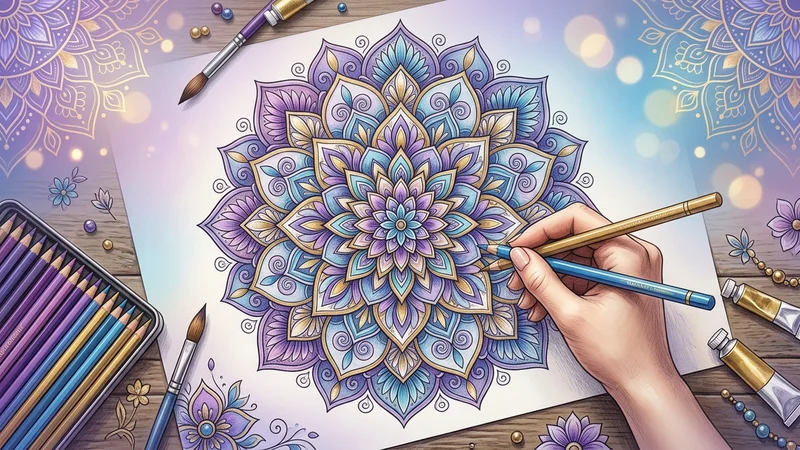
To color a mandala with pleasure, the choice of materials is essential. It is not about buying the most expensive supplies, but those that provide you with the best glide and a visual result that satisfies you. Here are the must-have items to start your collection:
Coloring tools
- Colored pencils: Ideal for beginners, they allow for precise control of lines and easy layering of shades. Opt for soft leads to create smoother gradients.
- Fine-tip markers: Perfect for complex mandalas with tight spaces. They offer vibrant and intense colors. However, be careful to choose water-based markers to prevent them from bleeding through the paper.
- Alcohol markers: Reserved for more experienced users, they allow for perfect flat tints without streak marks, but require suitable paper.
- Glitter or metallic gel pens: Fantastic accessories to add touches of light and relief to your finest details.
The surface: Paper makes all the difference
Never neglect the quality of your paper. A weight that is too thin risks buckling under the moisture of markers or letting colors bleed through to the back. Choose paper of at least 120g/m² for an optimal experience.
The step-by-step method: How to approach your mandala stress-free
One question often comes up for beginners: where do I start? Is there a golden rule? In reality, coloring a mandala is an intuitive experience, but following a certain methodology can help you better structure your session.
Should you start from the center or the outside?
There is no single answer; it all depends on your intention. Here are the two most common approaches:
- Moving from the center outward: This is the traditional method. The center represents your inner "self." By coloring outward, you symbolize the expansion of your energy, openness to the world, and personal growth. It is an ideal approach if you feel introverted and wish to reconnect with yourself.
- Moving from the outside inward: This technique is often perceived as a process of refocusing. By heading toward the heart of the mandala, you protect yourself from external noise to return to your deep essence. It is an excellent method to calm significant mental agitation.
A few tips for a smooth progression
To succeed with your coloring, always start with the largest areas to define your color palette, then finish with the details. Don't forget to place a scrap sheet of paper under your hand to avoid smudging the design, especially if you are using markers or oil-based pencils.
Advanced techniques to enhance your mandalas: Beyond simple filling
Once you have mastered the basics, you will likely want to add more depth to your creations. Coloring a mandala then becomes a true artistic exercise where you can play with light and textures.
Mastering gradients and nuances
To create volume, don't settle for a solid color. Try the gradient technique: use a dark color on the edges of a shape and gradually lighten toward the center by reducing the pressure on your pencil. You can also combine two complementary colors to create a harmonious transition that will bring your drawing to life.
Playing with textures
If you use colored pencils, don't hesitate to vary the pressure. A firm stroke creates a dense and vibrant color, while a light stroke creates a delicate transparency. For highly detailed mandalas, use gel pens to outline the contours: this provides a professional finish and a precious luster to your work.
The psychology of color: The importance of choice
The choice of colors is never trivial. Listen to your current needs:
- Blues and greens: To promote calm, serenity, and reduce anxiety.
- Reds and oranges: To stimulate energy, creativity, and passion.
- Yellows and golds: To bring joy, optimism, and mental clarity.
The hidden benefits of this creative practice
Why do so many people include coloring in their wellness routine? The benefits of mandala coloring are scientifically recognized. By focusing on a repetitive pattern, the brain slows its wave frequency, which promotes a state of deep relaxation similar to mindfulness meditation.
This activity significantly reduces cortisol levels (the stress hormone), improves eye-hand coordination, and develops patience. Ultimately, coloring a mandala is not a quest for perfection, but a quest for well-being. The aesthetic result is secondary to the inner peace you feel during the process.
Embark on your creative adventure now
Now that you have all the keys to get started, it is time to take action. Don't let this creative urge fade: the mandala is a faithful companion that awaits you whenever you need a moment of calm.
To guide you in your first steps, we have selected a series of exclusive designs for you, suitable for all levels, from the simplest to the most sophisticated. Download our printable templates for free and begin your journey toward serenity today. Once your masterpiece is finished, we would love to see it! Share your creations on our social media with the hashtag #MyColoredMandala and join our community of enthusiasts. Ready to color?