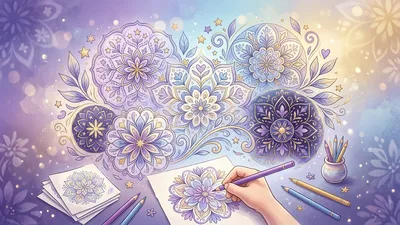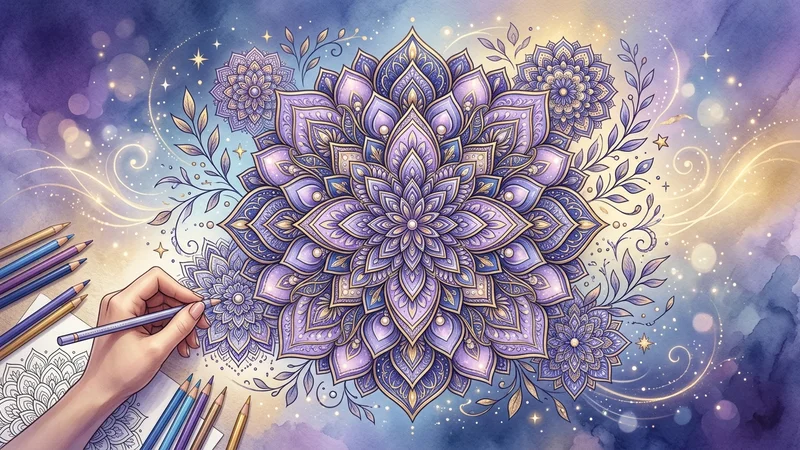
Have you ever come home after a grueling day, your brain buzzing, desperately looking for a way to disconnect? If you think colored pencils are just for classrooms, think again. In recent years, an ancient practice has made a powerful comeback in our living rooms: mandala stress coloring. Far from being a simple pastime to keep your hands busy, coloring has become a true tool for well-being, championed by psychologists and personal development enthusiasts around the world.
The Art of Coloring: More Than Just a Hobby for Adults
Not long ago, coloring was seen as an activity exclusively for children. However, the meteoric success of adult coloring books proves that we all, regardless of our age, have a visceral need to return to simple, creative gestures. Faced with the constant presence of screens and daily information overload, mandala stress coloring offers a welcome break, a refuge where time seems to stand still.
This trend is not just a passing fad. It is part of a global quest for balance. By focusing on filling in a complex pattern, adults manage to set their worries aside, giving their minds the rest they so desperately need. It is a gateway to mindfulness, accessible without any artistic prerequisites.
The Science Behind the Mandala: Why Our Brains Love These Patterns
But why the mandala in particular? Why not just doodle on a blank sheet of paper? The answer lies in the very structure of the mandala. These circular patterns, which start from a center and flourish outward, are deeply rooted in the human unconscious.
Geometric Harmony and Emotional Regulation
The human brain is programmed to seek patterns and order. When you engage in mandala stress coloring, you stimulate brain areas linked to fine motor skills and visual concentration, while calming the limbic system, the seat of our emotions. The repetition of geometric shapes acts as a safety signal for our nervous system:
- Symmetry: It provides a sense of order and predictability.
- Repetitive movement: It induces a state close to light hypnosis or a soothing trance.
- Closed structure: It offers a reassuring framework that helps contain diffuse anxiety.
The Role of Art Therapy in Stress Management
Mandala art therapy uses these properties to allow for non-verbal expression. Sometimes, words are not enough to describe mental tension or fatigue. By choosing colors and filling in the spaces, you externalize your internal state without needing to analyze it. It is a gentle and silent form of emotional release.
"The mandala is the mirror of the soul. By coloring it, you are not just filling in boxes; you are reorganizing your inner world to regain calm and clarity."
Mandala Coloring as a Form of Active Meditation
Many people associate meditation with total stillness, which can be intimidating for the most restless minds. Mandala stress coloring is an excellent alternative because it is a form of active meditation.
Entering the "Flow" State
In psychology, the concept of "Flow" describes an experience where you are so absorbed in an activity that you lose track of time and external concerns. Coloring allows you to reach this state quickly. By focusing all your attention on the tip of the pencil as it glides across the paper, you cut short the incessant stream of anxious thoughts.
Long-Term Benefits of Adult Coloring
Practicing coloring regularly helps to:
- Reduce anxiety naturally: By lowering heart rate and blood pressure.
- Improve concentration: By training your brain to focus on a single task.
- Promote sleep: By replacing the blue light of screens with a relaxing activity before bedtime.
Practical Guide: 5 Steps to Start Your Anti-Stress Coloring Session
Do you want to integrate mandala stress coloring into your routine, but don't know where to start? Follow this simple guide to turn your session into a true ritual of well-being.
1. Create Your Sanctuary
Choose a quiet, well-lit, and above all, comfortable place. Put your phone away and, if possible, play soft music or ambient sound (rain, forest, relaxing frequencies). The environment plays a key role in coloring to relax effectively.
2. Choose Your Tools With Care
Don't pressure yourself with professional equipment. Decent quality colored pencils or fine-tip markers are enough. The important thing is to choose colors that attract you instinctively at that moment. Don't look for aesthetic perfection; look for the pleasure of the movement.
3. Let Go of the Result
This is the most important step: forget about the final result. A mandala is not a painting intended to be displayed in a gallery. It is a process. If you color outside the lines or don't like a color, it doesn't matter. The goal is to reduce anxiety naturally, not to create a perfect work of art.
4. Breathe in Rhythm
Synchronize your breathing with your movements. Inhale while preparing your color, exhale deeply while you color an area. This amplifies the soothing effect and reinforces the meditative dimension of the exercise.
5. Practice in Small Doses
There is no need to spend hours on it. Fifteen to twenty minutes are enough to feel the benefits of adult coloring. Make it a daily routine, for example, when you get home from work or right before sleep, to mark a clean break from the tensions of the day.
Start Your Journey Toward Serenity Now
The road to a calmer mind is sometimes paved with complications, but the solution can be as simple as a sheet of paper and a few pencils. Mandala stress coloring is a powerful, accessible, and deeply rewarding tool that is waiting just for you. By giving yourself this time, you aren't just coloring: you are giving yourself the right to slow down and take care of yourself.
Ready to take the first step toward a more serene life? We have prepared an exclusive selection of mandalas designed specifically to promote deep relaxation. Download our free mandalas now and start your wellness routine today. It is time to add color to your mind and let the stress evaporate, one stroke at a time.